
In cloud computing, the “as a Service” (aaS) model delivers resources and capabilities on demand over the internet, usually on a pay-as-you-go basis. This shifts infrastructure ownership, maintenance, and management from the user to the service provider.
1. Lab as a Service (LaaS)
Definition: On-demand provisioning of pre-configured lab environments—physical or virtual—dedicated to tasks such as testing, development, research, or experimentation.
What it offers: Ready-to-use environments with the necessary hardware, software, tools, and configurations.
User responsibility: Focus on work inside the lab; the provider handles setup, infrastructure, and maintenance.
Key characteristics:
- Versatile: Supports diverse domains (software, hardware, research).
- Pre-configured: Includes essential tools and software.
- Isolated: Dedicated, sandboxed environments.
Use cases: Software testing, infrastructure validation, PoC development, hardware testing, research.
Analogy: Renting a fully equipped workshop or science lab.
2. Virtual Lab as a Service (VLaaS)
Definition: A subset of LaaS that uses virtualization to deliver cloud-based replicas of IT environments.
What it offers: Interactive virtual networks, systems, and tools, mimicking physical setups.
User responsibility: Operate within the virtual lab; provider manages infrastructure and virtualization platform.
Key characteristics:
- Scalable & flexible: Provision and scale on demand.
- Cost-effective: No physical hardware needed.
- Accessible: Internet-based, location-independent.
Use cases: Hands-on training, sandbox testing, software demos, configuration experiments.
Analogy: A digital replica of a workshop—flexible, portable, and hardware-free.
3. Environment as a Service (EaaS)
Definition: Broad service delivering complete, pre-configured environments for development, testing, training, or production.
What it offers: Fully set up workspaces with OS, applications, databases, network settings, and sometimes sample data.
User responsibility: Perform tasks within the environment; provider ensures availability and scalability.
Key characteristics:
- Holistic: All components for a specific task.
- Time-saving: Immediate usability.
- Consistent: Identical setups across teams.
Use cases: Agile dev/test cycles, CI/CD pipelines, prototyping, customer demos.
Analogy: Renting a fully furnished office, ready to work in.
4. Training Environment as a Service (TEaaS)
Definition: Specialized EaaS/VLaaS for scalable, hands-on training experiences.
What it offers: Pre-configured virtual labs, learning modules, CMS, learner tracking, and sometimes gamification/assessment tools.
User responsibility: Engage with learning content and practice skills; provider runs the platform and infrastructure.
Key characteristics:
- Education-focused: Designed for learning efficiency.
- Scalable: Supports many concurrent learners.
- Isolated: Safe for experimentation.
Use cases: Corporate training, IT certifications, academic programs, product demos.
Analogy: A virtual classroom, fully equipped and ready to use.
5. Cybersecurity Lab as a Service (CLaaS)
Definition: A highly specialized LaaS/VLaaS tailored for cybersecurity training, testing, and research.
What it offers: Virtual environments with vulnerable systems, attack/defense tools, SIEM platforms, and simulated traffic.
User responsibility: Conduct cybersecurity exercises; provider ensures realism and security.
Key characteristics:
- Realistic & safe: Practice real-world cyber scenarios risk-free.
- Specialized tools: Full cybersecurity toolkit.
- Repeatable scenarios: Consistent training environments.
Use cases: Ethical hacking, incident response drills, VAPT, cyber range exercises, research.
Analogy: A virtual shooting range for cyber professionals.
Comparative Relationships
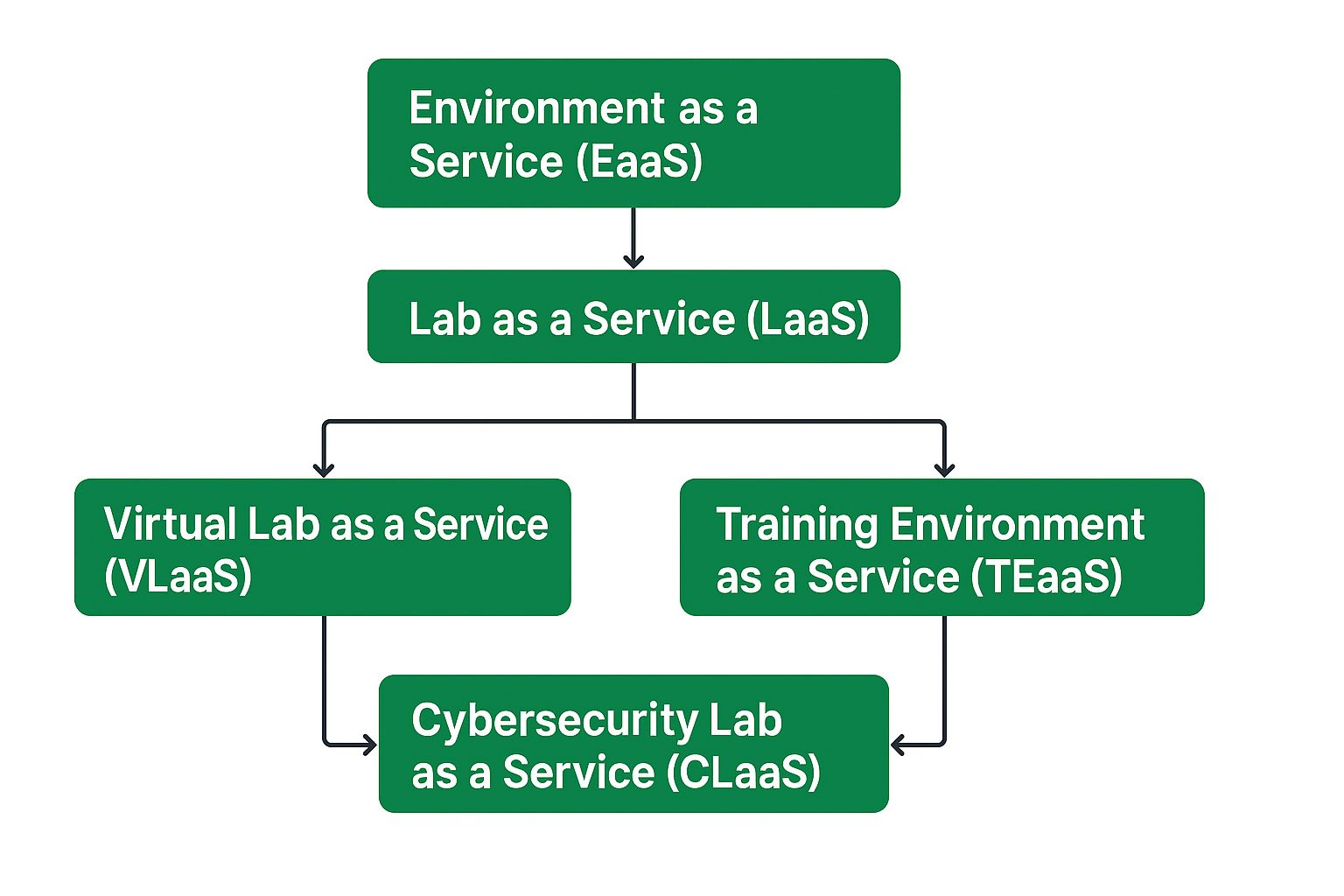
The hierarchy is as follows:
- EaaS – Broadest concept: ready-to-use environments.
- LaaS – EaaS for lab purposes.
- VLaaS – Virtualized form of LaaS.
- TEaaS – EaaS/VLaaS specialized for training.
- CLaaS – LaaS/VLaaS specialized for cybersecurity.
|
Aspect |
EaaS |
LaaS |
VLaaS |
TEaaS |
CLaaS |
|
Scope |
Any environment |
Lab-focused |
Virtual labs only |
Training-focused |
Cybersecurity-focused |
|
Core Offering |
Full workspace |
Testing/research labs |
Virtual IT labs |
Learning platform + labs |
Cybersecurity labs |
|
Tech Base |
IaaS, virtualization |
Physical/virtual |
Virtualization |
Built on VLaaS + LMS |
Built on VLaaS + security tools |
|
Primary Goal |
Faster workflows |
Isolated testing |
Hands-on virtual access |
Effective training |
Safe cyber practice |
|
Example Use Case |
CI/CD, prototyping |
HW/SW testing |
Sandbox demos |
IT certification |
Pen testing drills |